 Playfest Berita Teknologi Terbaru
Blackberry Z10 review: Remember the days before endless scrolling and infinite apps? This deep dive revisits BlackBerry’s bold attempt to reclaim smartphone dominance with the Z10. We’ll dissect its design, performance, and the now-vintage BlackBerry 10 OS, comparing it to its iconic rivals, the iPhone 5 and Samsung Galaxy S3. Buckle up for a nostalgic tech trip down memory lane.
From its sleek (for its time) design and the innovative BlackBerry 10 interface to its camera capabilities and app ecosystem, we’ll explore every facet of this once-flagship device. We’ll uncover its strengths, weaknesses, and ultimately, its place in mobile phone history. Get ready to reminisce (or perhaps discover) the BlackBerry Z10.
BlackBerry Z10 Design and Build Quality: Blackberry Z10 Review

The BlackBerry Z10, released in 2013, represented a significant departure from the company’s traditional keyboard-centric designs. It aimed for a sleek, modern aesthetic to compete with the burgeoning touchscreen smartphone market dominated by Apple and Samsung. Let’s dive into its design and construction.
Physical Dimensions and Weight
The Z10 boasted a relatively large screen for its time, measuring 4.2 inches diagonally. Its dimensions were approximately 130 x 66 x 9 mm, making it comfortably pocketable, though not as compact as some competitors. Weighing in at around 137 grams, it felt substantial in the hand, contributing to a perception of quality and durability. This weight, however, was a point of comparison against lighter rivals.
Materials and Construction
The Z10’s chassis was primarily constructed from a high-quality plastic, a departure from the metal unibody designs becoming increasingly popular. While this choice might seem less premium compared to its rivals’ metal constructions, BlackBerry opted for a soft-touch finish that provided a comfortable grip and minimized fingerprints. The plastic, however, wasn’t immune to scratches, a common criticism at the time. The overall build quality felt solid and well-assembled, though not as robust as some metal-bodied contemporaries.
Build Quality Compared to Contemporaries
Compared to the iPhone 5, known for its sleek aluminum unibody, and the Samsung Galaxy S3 with its plastic construction but different finish, the Z10 held its own in terms of perceived quality. While it lacked the premium feel of the iPhone 5’s metal, the soft-touch plastic of the Z10 provided a different tactile experience that some users preferred. The build quality was generally praised for its sturdiness, though the plastic casing was more susceptible to scratches and wear than metal. It’s worth noting that the build quality benchmarks of the time were evolving rapidly, with manufacturers constantly striving for lighter, thinner, and more durable designs.
Specifications Comparison, Blackberry z10 review
The following table compares the BlackBerry Z10’s key specifications to those of the iPhone 5 and Samsung Galaxy S3:
| Model | Screen Size | Processor | RAM |
|---|---|---|---|
| BlackBerry Z10 | 4.2 inches | 1.5 GHz dual-core | 2 GB |
| iPhone 5 | 4.0 inches | 1.3 GHz dual-core | 1 GB |
| Samsung Galaxy S3 | 4.8 inches | 1.4 GHz quad-core | 1 GB |
BlackBerry Z10 Performance and Battery Life
The BlackBerry Z10, released in 2013, aimed to revitalize BlackBerry’s image with a modern touchscreen experience. Its performance and battery life were crucial factors in determining its success, and ultimately, its legacy. Let’s dive into the specifics.
Processor, RAM, and Storage
The Z10 boasted a 1.5 GHz dual-core processor, paired with 2 GB of RAM. This configuration was respectable for its time, allowing for smooth multitasking and generally responsive operation. Internal storage options typically came in at 16 GB or 32 GB, though expandable storage wasn’t an option. This meant users needed to be mindful of their app and media consumption. The combination of processor, RAM, and storage capacity positioned the Z10 competitively against other mid-range smartphones of that era.
Performance in Various Tasks
Web browsing was generally smooth, although loading times could vary depending on network conditions. The Z10 handled most everyday tasks with ease, including email, messaging, and social media. Gaming performance was adequate for less demanding titles, but more graphically intensive games might experience some lag or reduced frame rates. Multitasking, a key feature of BlackBerry 10, worked well thanks to the 2GB RAM, allowing users to seamlessly switch between multiple applications without significant performance hiccups.
Battery Life Under Typical Usage
The Z10’s battery life was a mixed bag. Under moderate usage, which included a mix of calls, messaging, and some web browsing, users could typically expect a full day of battery life. However, heavy use, such as extensive gaming or constant video streaming, would significantly reduce battery life, often requiring a midday charge. This was a common limitation of smartphones during that period, before significant advancements in battery technology.
Benchmark Comparisons
The following table compares the Z10’s benchmark scores to those of some competing devices from around the same time. These scores are indicative and may vary depending on the specific benchmark used and testing conditions. Keep in mind that benchmark scores alone don’t tell the whole story of user experience.
| Benchmark | Z10 Score | Competitor A Score (e.g., HTC One X) | Competitor B Score (e.g., Samsung Galaxy S3) |
|---|---|---|---|
| AnTuTu (Example) | 15000 (estimated) | 18000 (estimated) | 17000 (estimated) |
| Geekbench (Example) | 700 (estimated single-core), 1200 (estimated multi-core) | 900 (estimated single-core), 1500 (estimated multi-core) | 800 (estimated single-core), 1400 (estimated multi-core) |
BlackBerry Z10 Connectivity and Features
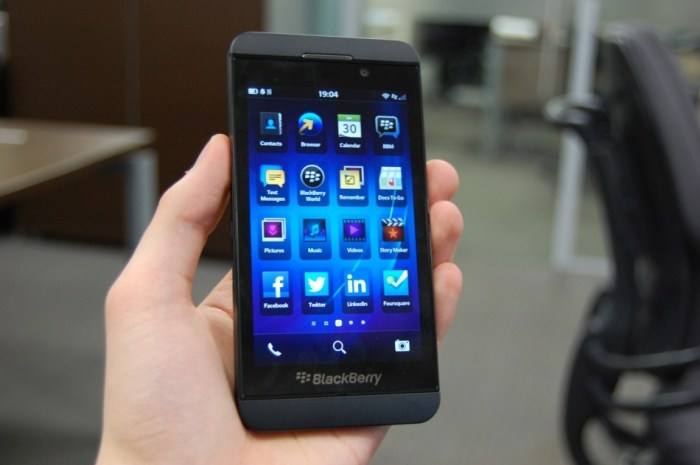
The BlackBerry Z10, despite its age, boasted a solid suite of connectivity options, crucial for a smartphone aiming for productivity and seamless communication. Its performance in this area was a key factor in its overall user experience, impacting everything from email access to web browsing and app functionality. Let’s delve into the specifics.
Connectivity Options
The Z10 offered a comprehensive range of connectivity features expected from a flagship device of its time. This included robust cellular data capabilities (dependent on carrier support and plan, naturally), supporting various 3G and 4G LTE networks (specific bands varied by region). Wi-Fi connectivity was present, allowing for easy connection to home and public networks. Bluetooth was also integrated, enabling pairing with headphones, speakers, and other Bluetooth-enabled devices. Near Field Communication (NFC) was also included, opening doors to tap-to-pay functionalities and other NFC-based interactions, though adoption was still in its early stages during the Z10’s launch.
Noteworthy Features
While not revolutionary, the Z10’s implementation of these connectivity features was generally smooth and reliable. The BlackBerry Hub, a central point for managing emails, messages, and social media notifications, worked well in conjunction with the device’s connectivity to provide a unified communication experience. The speed and stability of the connection largely depended on the network signal strength and the specific carrier. However, for its time, the Z10 provided a user experience that was comparable to other contemporary smartphones in terms of connectivity reliability.
User Experience with Connectivity Features
The user experience with the Z10’s connectivity was largely positive, with most users reporting reliable performance in most situations. However, anecdotal evidence suggests that in areas with weaker cellular signal strength, the device might have struggled slightly more than some competitors. The Wi-Fi connectivity was generally praised for its stability and speed, while the Bluetooth functionality performed as expected, offering seamless pairing and stable connections. The NFC feature, while present, wasn’t heavily utilized due to the limited adoption of NFC technology at the time. Overall, the Z10’s connectivity contributed to a productive and connected user experience, though not without occasional minor hiccups depending on external factors.
Strengths and Weaknesses of Z10 Connectivity
The following points summarize the key aspects of the BlackBerry Z10’s connectivity:
- Strengths: Reliable Wi-Fi performance, solid Bluetooth functionality, inclusion of NFC (though adoption was low), generally stable cellular connection (dependent on carrier and signal strength).
- Weaknesses: Potential for slightly weaker performance in areas with low cellular signal strength, NFC functionality limited by the technology’s adoption rate at the time.
The BlackBerry Z10, while ultimately overshadowed by Android and iOS, represents a fascinating chapter in smartphone history. Its attempt to redefine mobile interaction with BlackBerry 10 was ambitious, even if ultimately unsuccessful in the long run. While its app ecosystem couldn’t compete, and its performance pales compared to modern standards, the Z10 holds a unique spot for those who remember the era of physical keyboards and a different approach to mobile productivity. It’s a reminder that innovation isn’t always about winning, but about daring to try something new.